

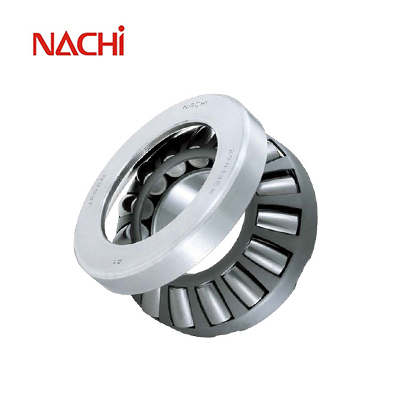
Self-aligning roller bearings feature two rows of rollers, primarily designed to bear radial loads while also accommodating axial loads in either direction. They possess high radial load capacity, making them particularly suitable for heavy-duty or vibration-prone applications, though they cannot withstand pure axial loads. The outer ring raceway is spherical in shape, conferring excellent self-aligning capability to compensate for misalignment errors.
Featuring two symmetrical rows of spherical rollers, the outer ring possesses a common spherical raceway, while the inner ring has two raceways inclined at an angle to the bearing axis. This design provides excellent self-aligning capability, allowing normal operation even when the shaft is deflected under load or mounted eccentrically. The self-aligning capacity varies with the bearing size series, typically permitting an angle of misalignment between 1 and 2.5 degrees. This bearing type possesses substantial load-carrying capacity, accommodating both radial loads and bidirectional axial loads while exhibiting good shock resistance. Generally, self-aligning roller bearings are suitable for lower operating speeds.
Self-aligning roller bearings are categorised by roller cross-section into two distinct structures: symmetrical spherical rollers and asymmetrical spherical rollers. Asymmetrical self-aligning roller bearings represent an earlier generation, primarily serving maintenance applications for existing machinery. Symmetrical self-aligning roller bearings are seldom selected for new machinery designs. Their internal structure has undergone comprehensive redesign and parameter optimisation. Compared to earlier self-aligning roller bearings, they can withstand greater axial loads. Operating at lower temperatures, these bearings accommodate higher rotational speeds. Based on the presence of flanges on the inner ring and the type of cage used, they are categorised into C-type and CA-type. C-type bearings feature an inner ring without flanges and employ a stamped steel cage. CA-type bearings feature flanges on both sides of the inner ring and employ a machined solid cage.
Self-aligning roller bearings are categorised by bore type: cylindrical bore or tapered bore. When mounted on a matching locking sleeve, they become K+H type and K30+H type bearings respectively.
These bearings may be mounted on smooth shafts without shoulders, being suitable for applications requiring frequent bearing installation and removal. To enhance lubrication performance, the outer ring is machined with an annular oil groove and three evenly spaced oil holes, designated by the suffix W33.
“Do you see over yonder, dear client, those tricky equipment bottlenecks, those wear-and-tear troubles that stall your production? I intend to arm your machines with genuine imported bearings—and stand by with technical support to slay every glitch that comes your way.”
— Hengzhou Bearings
leave a comment